Earn
Shielded USDC into Vesu lending markets and back, through a helper we deployed ourselves.
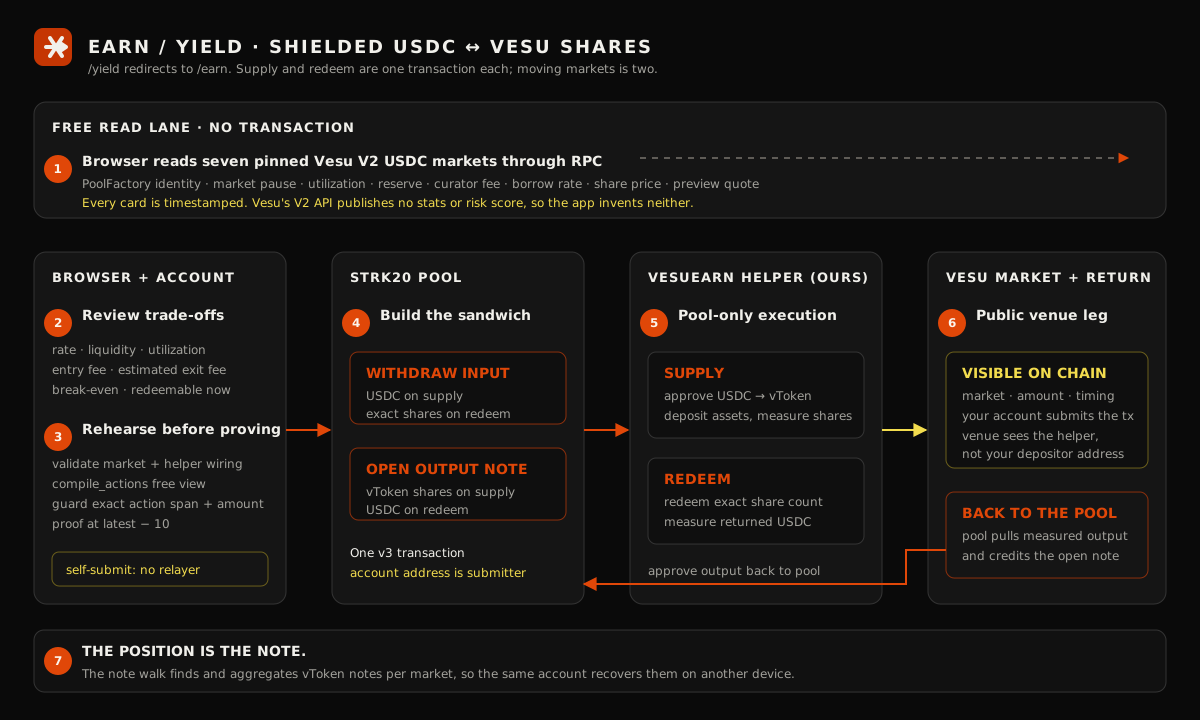
Earn is the third invoke sandwich, after swap and bridge, and it has the same shape: shielded USDC leaves the pool to a helper contract, the helper does one thing with it, and the proceeds come back into the pool as a private note — one transaction, and the value never touches a public address of yours in between.
What the helper does here is supply a Vesu lending market and hand back the shares.
The app calls this surface Earn. /yield is a working alias that redirects to /earn, so a
reader looking for yield reaches the same place rather than a separate product.
Seven markets, one protocol
Vesu is one protocol containing several isolated markets. A market is one pool/asset pair with its own rate, its own liquidity, and its own curator, and they can differ sharply. The cards carry the observation time because the figures move; this page does not freeze one day's ranking into prose.
All seven are in the catalog, including the empty one. A list that quietly drops the markets nobody is using teaches you that everything you can see is fine.
Every number is a contract read
Vesu's own API answers, and returns stats: null for every V2 pool — no rate, no price, no risk
rating. So none of the figures on this surface come from a feed. Each market's rate is computed from
its own pool contract:
supply rate = borrow rate × utilization × (1 − curator fee)with utilization, interest_rate, asset_config and is_paused all read live, and available
liquidity taken from the market's own unborrowed reserve. Every card says when it was read.
There is no risk score. The first-party feed publishes none, and inventing one would be us making up a number about somebody else's money.
What is public, and what is not
On chain: that our helper contract supplied a named Vesu market, the amount, and the timing. A vToken deposit is a plaintext ERC-4626 event and this documentation will not pretend otherwise.
Not on chain: which account owns the position. The supply arrives as a withdrawal from the pool, so the market records no depositor address of yours.
Earn is always submitted by your own account. It is not covered by a sponsored transaction — that is a product choice rather than a limitation — so your address is the visible sender, and the pool fee and gas come from your public STRK.
The position is the note
Supplying mints vToken notes into the pool. That is the position: there is no secret in your browser that owns it, and no server holding a record of it. A cleared browser, a new device, or a restored account finds it again from the note walk alone, which is a better property than the bearer claims that Markets and Launch positions use.
Redeeming, and the line that cost somebody money
The exit burns an exact share count — redeem(shares), not withdraw(assets).
This matters more than it sounds. The privacy SDK's published Vesu helper class called
withdraw(assets) on the way out; the corrected source calls redeem(shares), and the SDK's own
README still shows an exit passing an underlying amount two lines after it has discovered a share
balance. vToken shares are 18-decimal and USDC is 6-decimal, so the two numbers differ by roughly the
share price times a trillion.
The published helper class is not declared on mainnet at all, so there was nothing to point at even
if we had wanted to. Ours is built from the corrected source and deployed at
0x3ce7a79c53685ab178bcf36960099bf37bbd16035f0f7e2defefa5153204157 — pool-only, and holding nothing between
transactions. Before it went up it was driven against the real Vesu vTokens on a fork of
mainnet: all seven markets supply and redeem an exact share count, the shares returned match the
vault's own preview_deposit exactly, and the pool can pull what the helper approved. A mock could
not have caught a disagreement with Vesu, because a mock cannot disagree with the assumption it was
written from.
The app also refuses to prove a transaction whose compiled action list is not exactly the operation you reviewed.
What is worth taking out is not what it is worth
A lending market lends its deposits out, so "your position is worth X" and "you can withdraw X today" are different sentences — and the market paying the best rate is often the one where they differ most, because high utilization is both what pays and what makes leaving harder. The surface shows the value and the currently redeemable amount as two numbers, and never says funds are always immediately withdrawable.
Fees, said before you sign
A pool fee is charged per transaction whatever the size, so getting in and out of a small position costs the same as a large one. At the fee and rate current while this was written, a round trip cost about $0.32 — roughly 23 days of gross yield on $100, and about 229 days on $10.
The review shows the live entry fee, the estimated exit fee, and the break-even horizon before any proof is generated, because that arithmetic is the decision.
Moving between markets
A private pool transaction supports one external invocation, so moving a position is two transactions with two fees, not one. The plan shows both legs, and after the first one your money is shielded USDC and you can stop there. If the first leg's outcome is unknown the second is held back, and nothing is retried automatically — that is how a redemption gets done twice.